A Reading Path Down a Rabbit Hole: Aban Raza
Selected conversations, interviews and profiles with Indian oil painter Aban Raza
Quotes & images
Manuela Ciotti, Galerie Mirchandani + Steinruecke
The artist seems to be firmly rooted in the analogue: is her use of oil a reaction to the hyper-medialisation of the events she represents, accessed by most via digital media?
Her subjects are mainly drawn from the labouring classes but they are not just seen labouring in agricultural or other fields. As part of a long and multi-vocal set of political tradition(s) in India, they are embedded in fields of protest to claim their rights.
I wrote how the works on display could be seen as becoming alive and ‘storming out of the exhibition venue, taking to the streets and joining human protesters’.
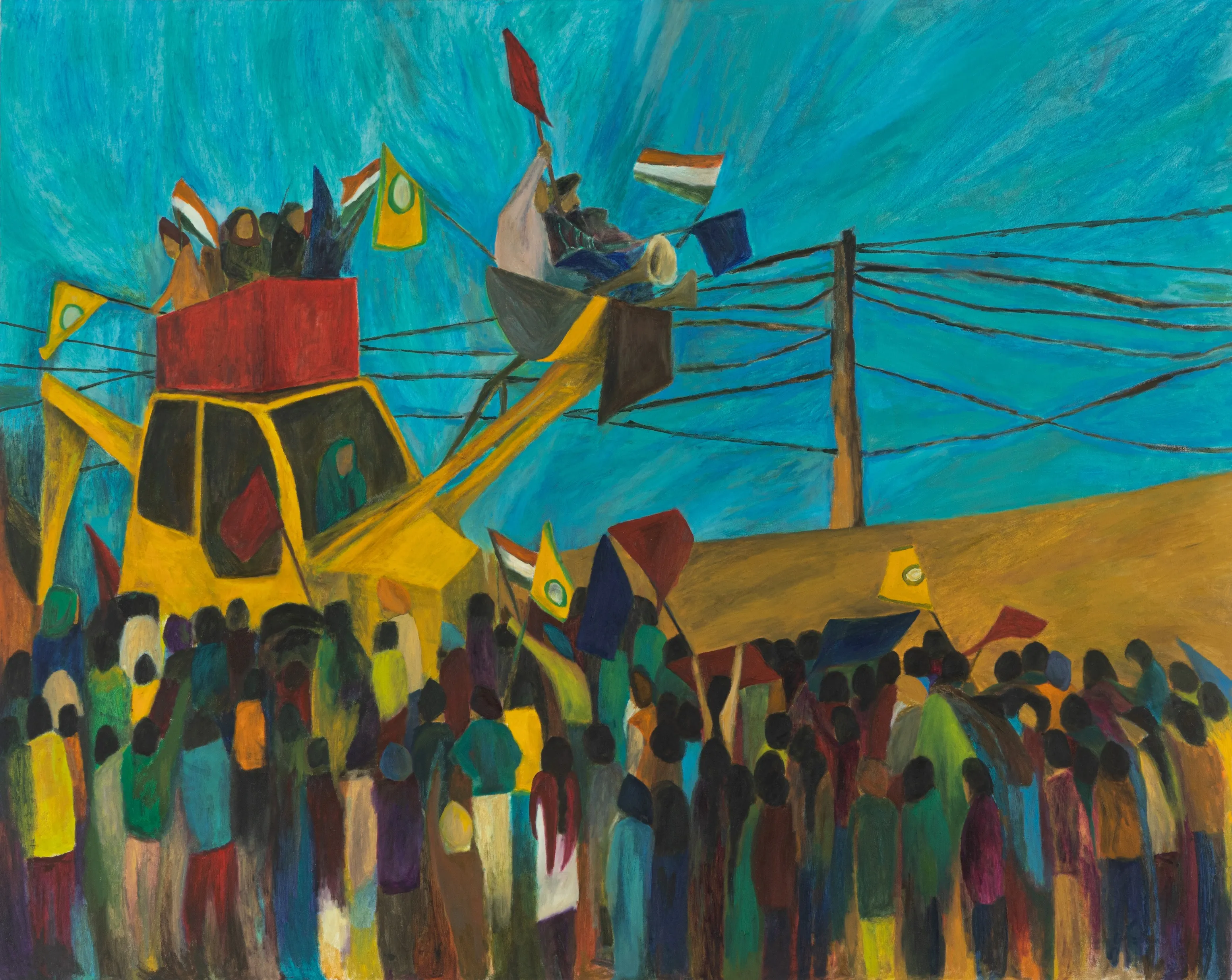
Republic Day, Tikri Border, Delhi-Haryana, 2021, Oil on canvas, 48 x 60 in / 121.9 x 152.4 cm
Ankan Kazi and Bhakti S. Hattarki, DAG
Q. Would you call your process primarily documentary in such cases?
Aban: I believe so because these narratives capture the lives of actual individuals—these are portraits. While they serve as documentation, they also carry an aspirational quality. There’s a particular joy I aim to convey through the notion of protesting or being part of a collective.
Q. Did you sketch or paint on-site?
Aban: At the protest site I am usually participating and helping out—which everyone is required to do. But I do come back (to my home/studio) and refer to photographs that I take with my phone camera…I would like to believe there’s a lot of imagination while I’m composing
Q. How do you see your attempt to make the grand old medium of oil painting, so to speak, into a medium for practicing a very politically sensitive and socially relevant resistance art today?…it’s interesting that you deliberately use this classical medium to do something so contemporary
Aban: …It’s a very wonderful medium. You can mould things, you can change things around; it takes a long time to dry so you know you can contemplate, you can sit with it. It’s quite a romantic relationship in a sense.
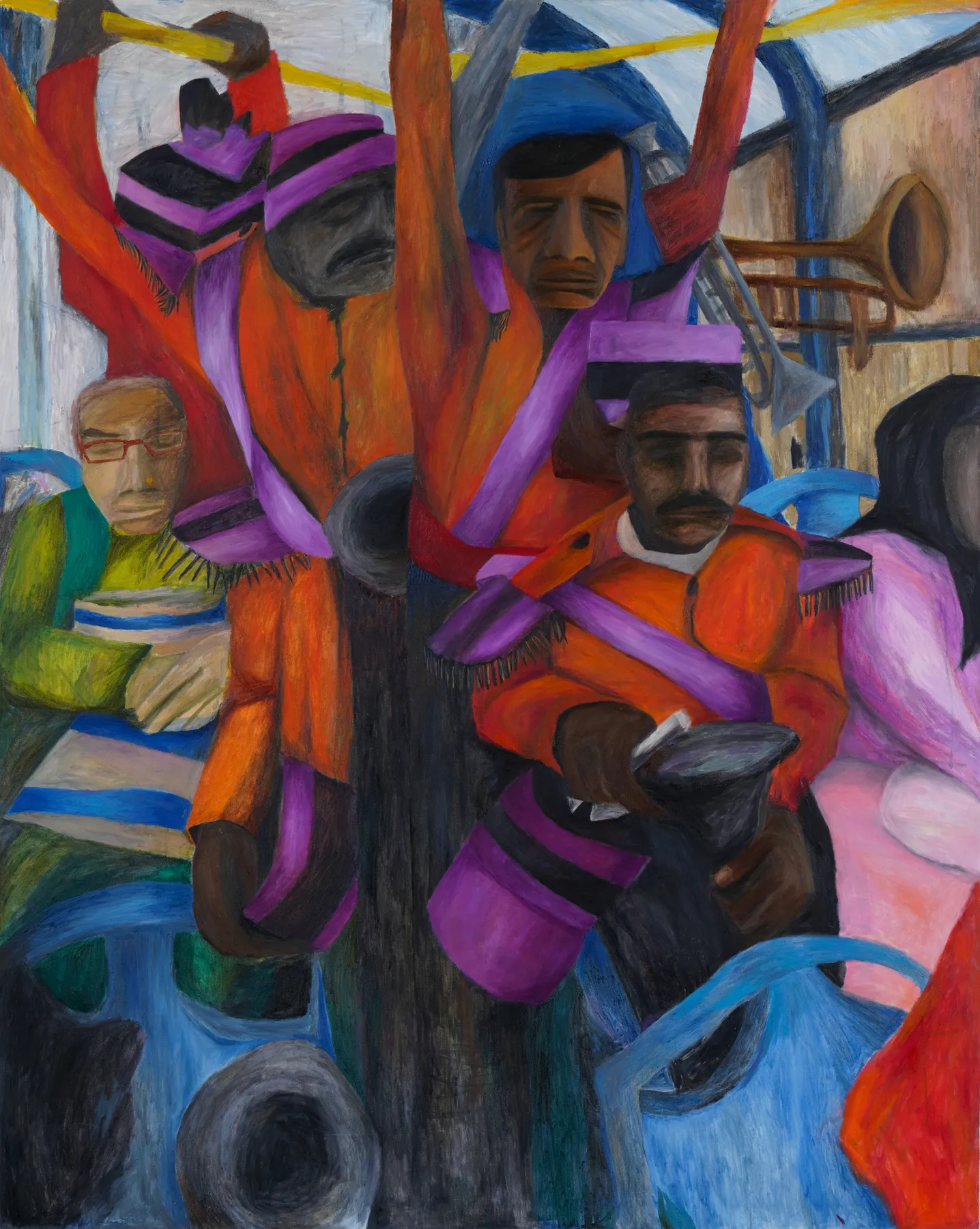
Delhi Bus, 2020, oil on canvas, 60 x 48 in / 152.4 x 121.9 cm
Gayatri Sinha, Galerie Mirchandani + Steinruecke
At first, you might mistake the image for a stage. The structural logic of the shamiana—three-sided, made of vividly coloured red, ochre and green canvas, and open on the fourth—creates the illusion of a recessed, room-like space, crowded with many actors, in short, a stage. What you see, however, is a site of dharna or a sit-in where the figures milling around, mostly women, veiled or with head covered, are staging a protest for better wages, the fulfilment of the promise of MGNREGA, and the implementation of speedier and more equitable laws. The location could be interchangeable—from Singhu border on the edge of Delhi to Shaheen Bagh to Bhim in Rajasthan—but in every case, the workers’ presence speaks of a churn and an insistent message for change.
As a printmaker in Garhi studios from 2013, for nearly a decade, she created posters in Hindi, Urdu and English. Their graphic quality and use of colour and text recall the visceral, affective posters of prominent Pakistani feminist artist, Lala Rukh.
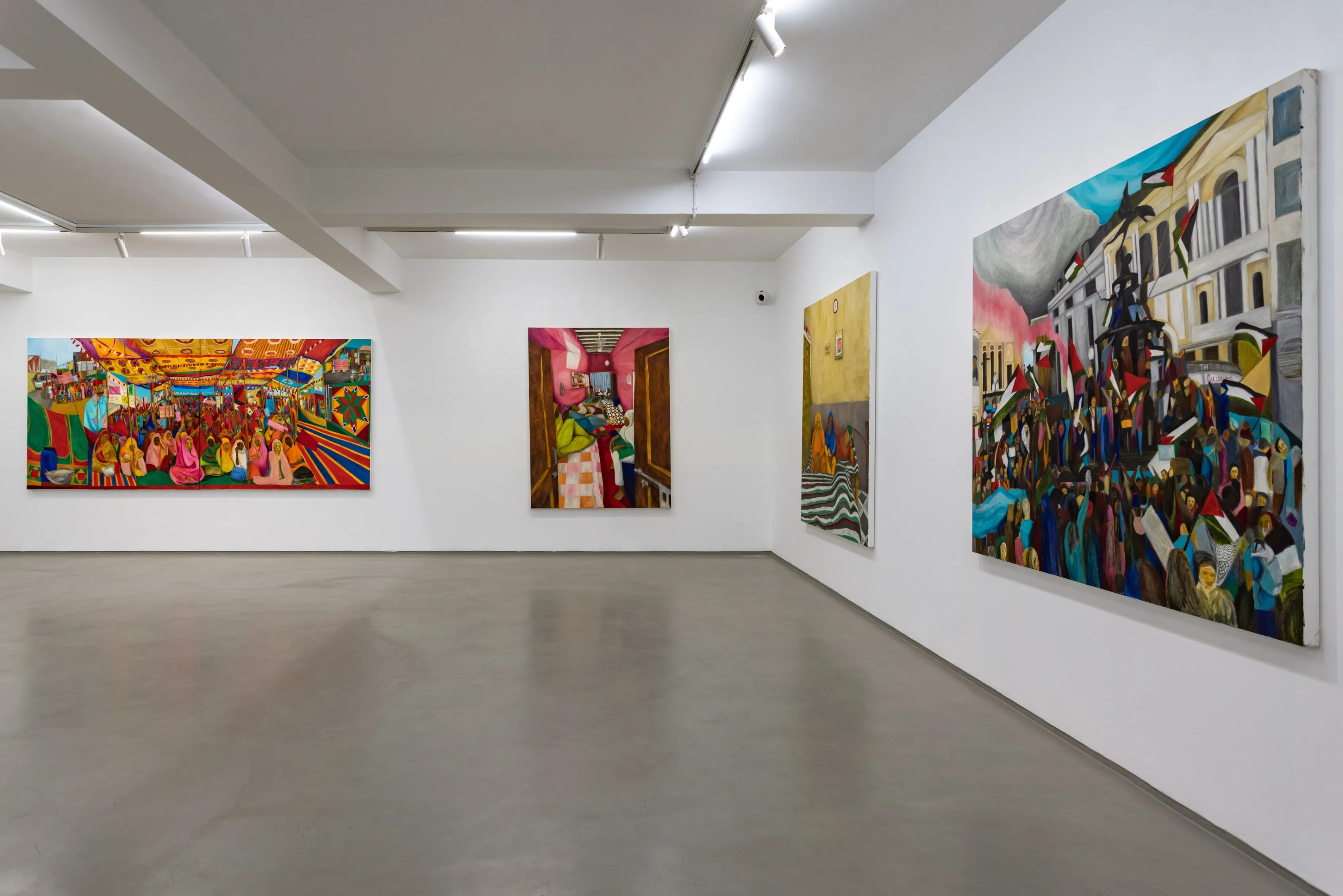
Installation view, Nothing Human Is Alien to Me, Galerie Mirchandani + Steinruecke, 2025
“We have seen very meaningful paintings in black and white that mostly show how there are no colours in a person’s life who is struggling,” a visitor commented on Raza’s artwork. The artist had the perfect answer for her. “When you enter a mela in Rajasthan, you are bombarded with colour. You cannot think in black and white,” she said. The colours, Raza added, had chosen her.
For the next few hours, the modest art gallery briefly turned into a classroom. Visitors also found themselves drawn into a conversation about the Right to Information Act and, inevitably, the state of the Indian democracy.
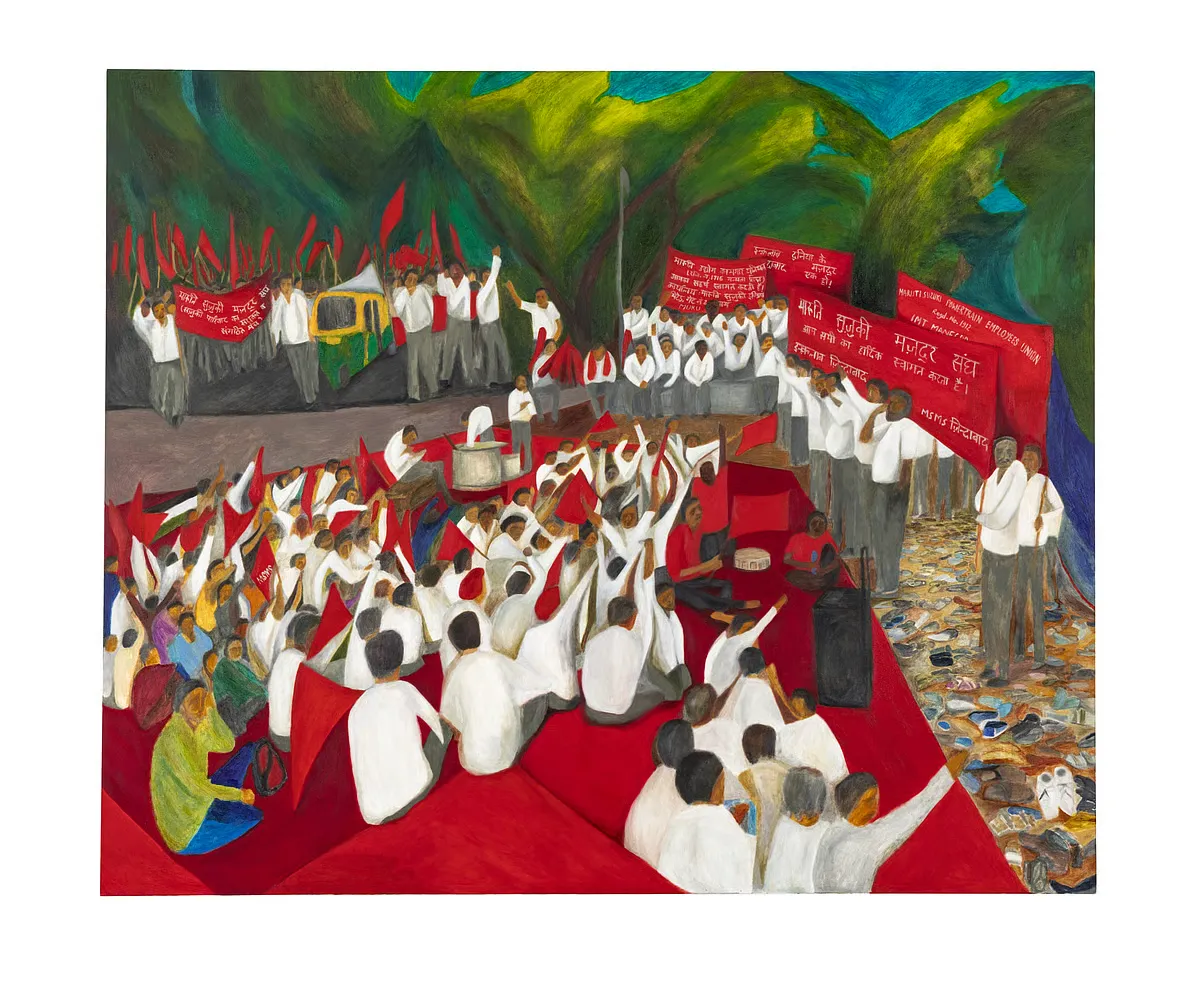
Maruti Suzuki Workers Union protest at the DC Office, Gurugram, July 18 2024. Photo: Aban Raza
Prachi Satrawal, The New Indian Express
Waiting is a key motif in Raza’s work. In Bhim Bus Stand (2025), women sit in a row, leaning into uncertainty. “I tried to capture this moment of pause after which you suddenly have to get up and run… you know what you are waiting for but you do not know when it will happen,” says the artist.
In the tent painting titled Maruti Suzuki Struggle Committee, IMT Chowk, Manesar Tehsil, Haryana (2024), bundles of blankets, durries and personal objects become memorials of an evicted protest site. A deliberate emphasis is placed on the blankets, sent in solidarity by workers from a nearby blanket factory who themselves could not join the protest.
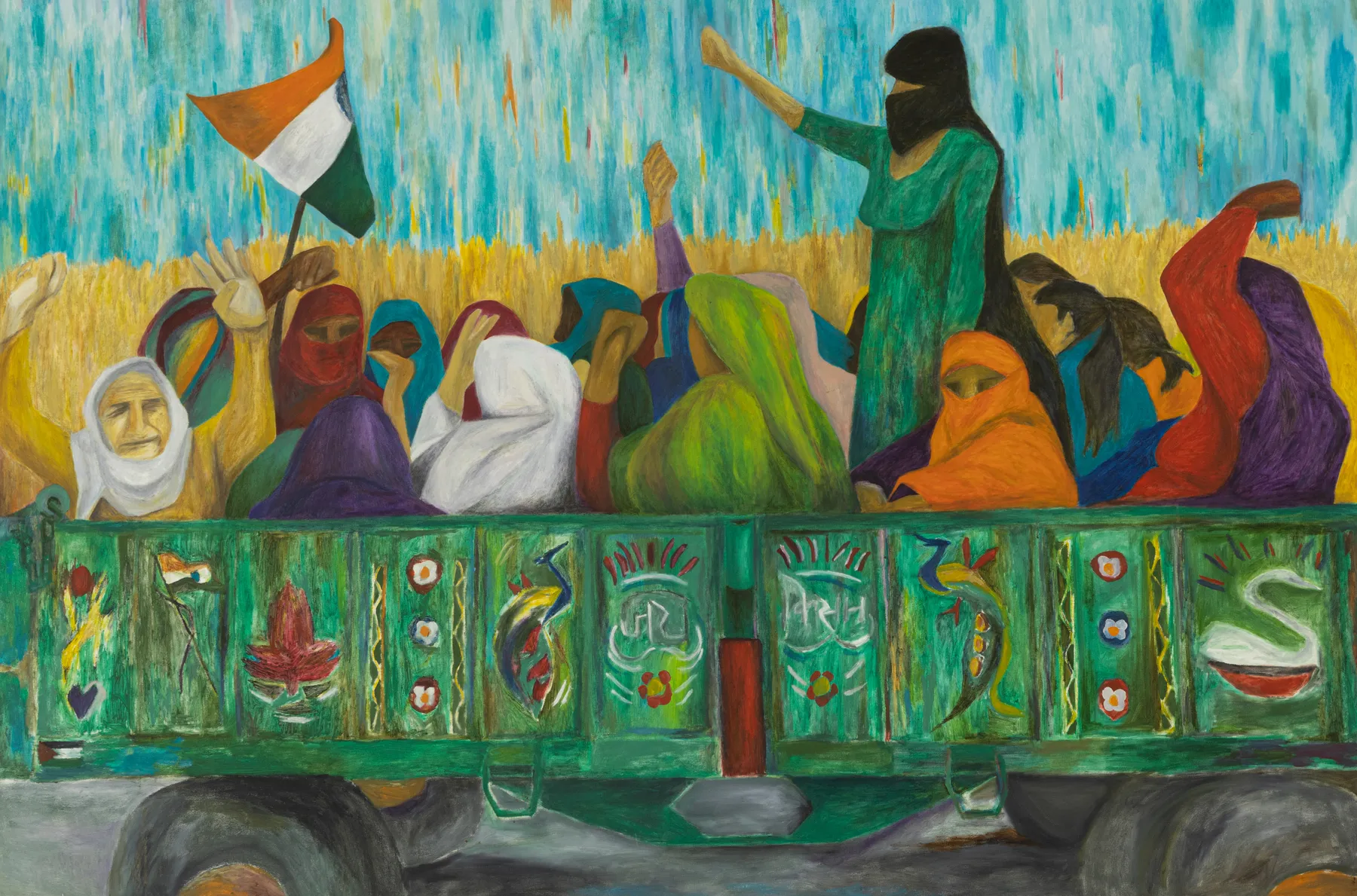
Tikri Border, Delhi-Haryana, 2021, Oil on canvas, 48 × 72 in / 121.9 x 182.8 cm
Kuch Hai Features
Profiles and interviews
- There is something tremendous about the blue sky (Manuela Ciotti, Galerie Mirchandani + Steinruecke, November 2022)
- Encounters with Faces: A conversation with Aban Raza (Ankan Kazi and Bhakti S. Hattarki, DAG, January 1, 2024)
- Nothing Human Is Alien to Me (Gayatri Sinha, Galerie Mirchandani + Steinruecke, October 2025)
- Inside 'Nothing Human Is Alien to Me': Aban Raza Paints the Politics of the Present (Rahul Dev, The Wire, November 23, 2025)
- Aban Raza's painting turns Delhi art gallery into a classroom on RTI, democracy (Nootan Sharma, ThePrint, December 2, 2025)
- There will be painting in dark times (Prachi Satrawal, The New Indian Express, December 12, 2025)
- Future Voices: Aban Raza & Prasiit Sthapit (Art South Asia Project (YouTube), June 18, 2024)