A Reading Path Down a Rabbit Hole: Fields of Sight by Gauri Gill and Rajesh Vangad
Selected conversations, interviews and profiles with the Indian artists behind the photograph and illustration book Fields of Sight
Quotes & images
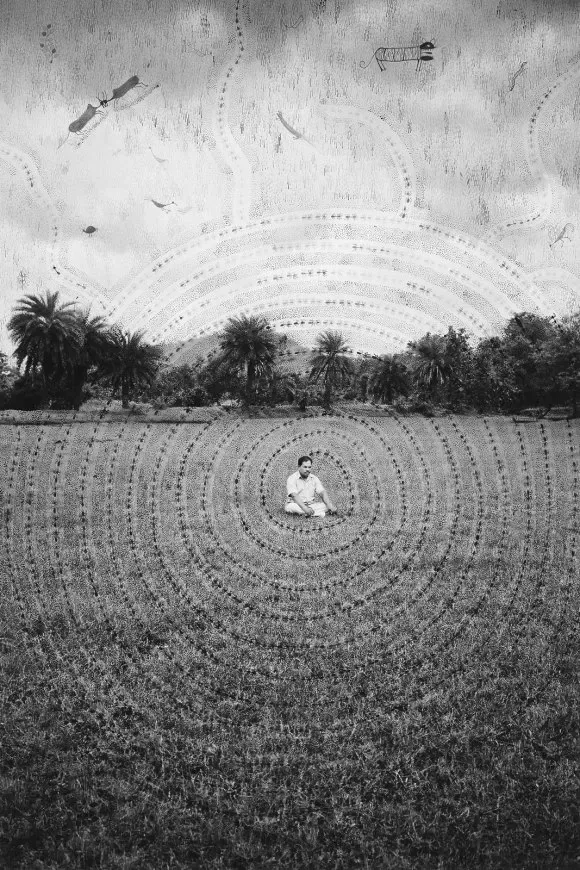
Fields of Sight (2013–), a series of Gauri Gill’s black-and-white photographs overlaid with images by Rajesh Vangad created in Warli tradition, is an ongoing collaborative project that attempts to reckon with the many layers of story, time, and space.
Gill captures Vangad in photos taken in varied urban and rural environments near Vangad’s home in the Indian state of Maharashtra. Vangad then supplies his own interpretation of the scenes through intricate and expressive ink paintings on large-scale prints of the photographs.
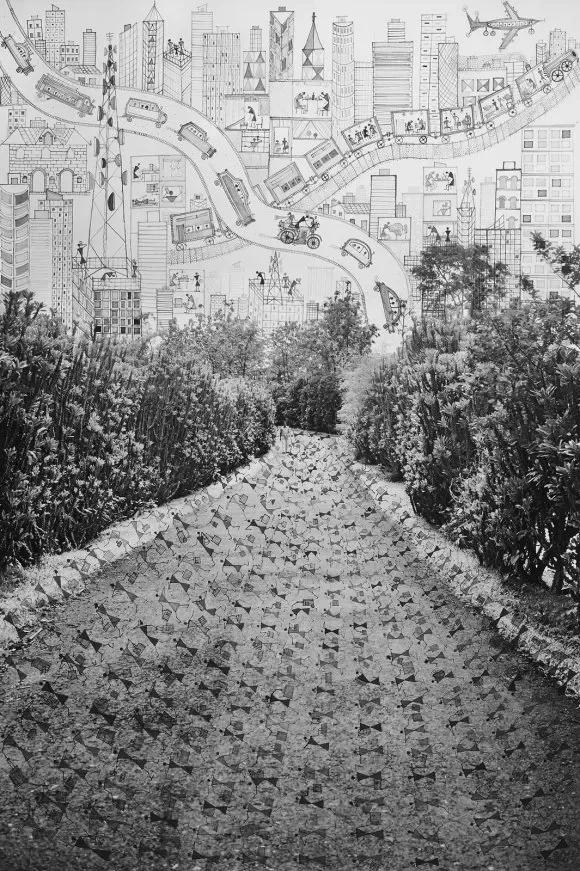
One of India’s largest thermal power plants is nearby, and the region’s indigenous people, including the people of the Warli tribe, have been displaced several times as a result of ongoing industrial development.
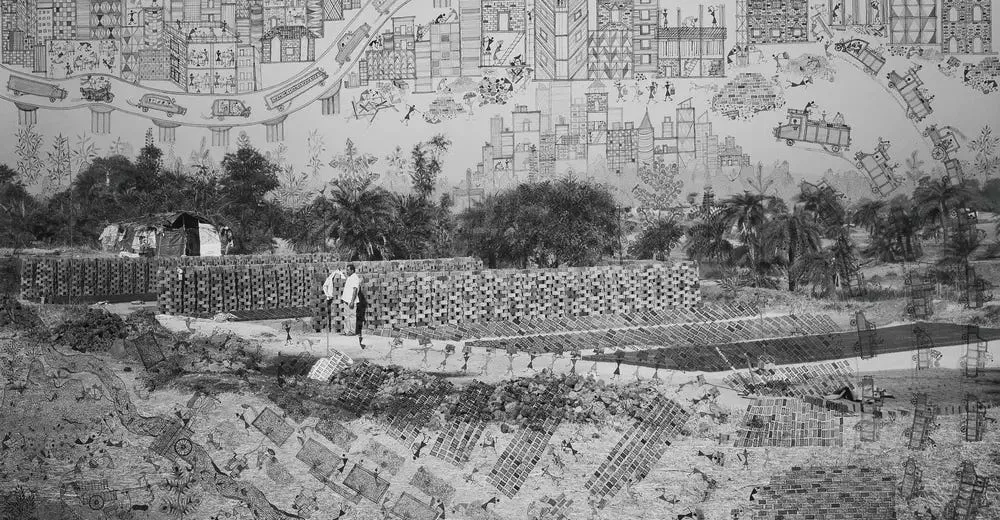
Through fusing photography and Warli painting, photographer Gauri Gill (b. 1970, India) and painter Rajesh Vangad (b. 1975, India) collaboratively reinvent the practice of painted photography, interweaving historical and generational painting practices into the photographic object.
The project began in 2013 in the Adivasi village of Ganjad, Dahanu. Vangad, who grew up in this landscape, served as Gill’s knowledgeable guide.
While Gill’s photographs captured the ever-changing qualities of the land, they fell short of revealing the hidden but essential elements beyond the visible. Vangad bridged this gap by embellishing Gill’s images with intricate drawings. His vivid narratives depict the multifaceted realities of Warli life in the region, from floods and droughts to family and village life, unrest and terror, spirits and myths, light and shadow.
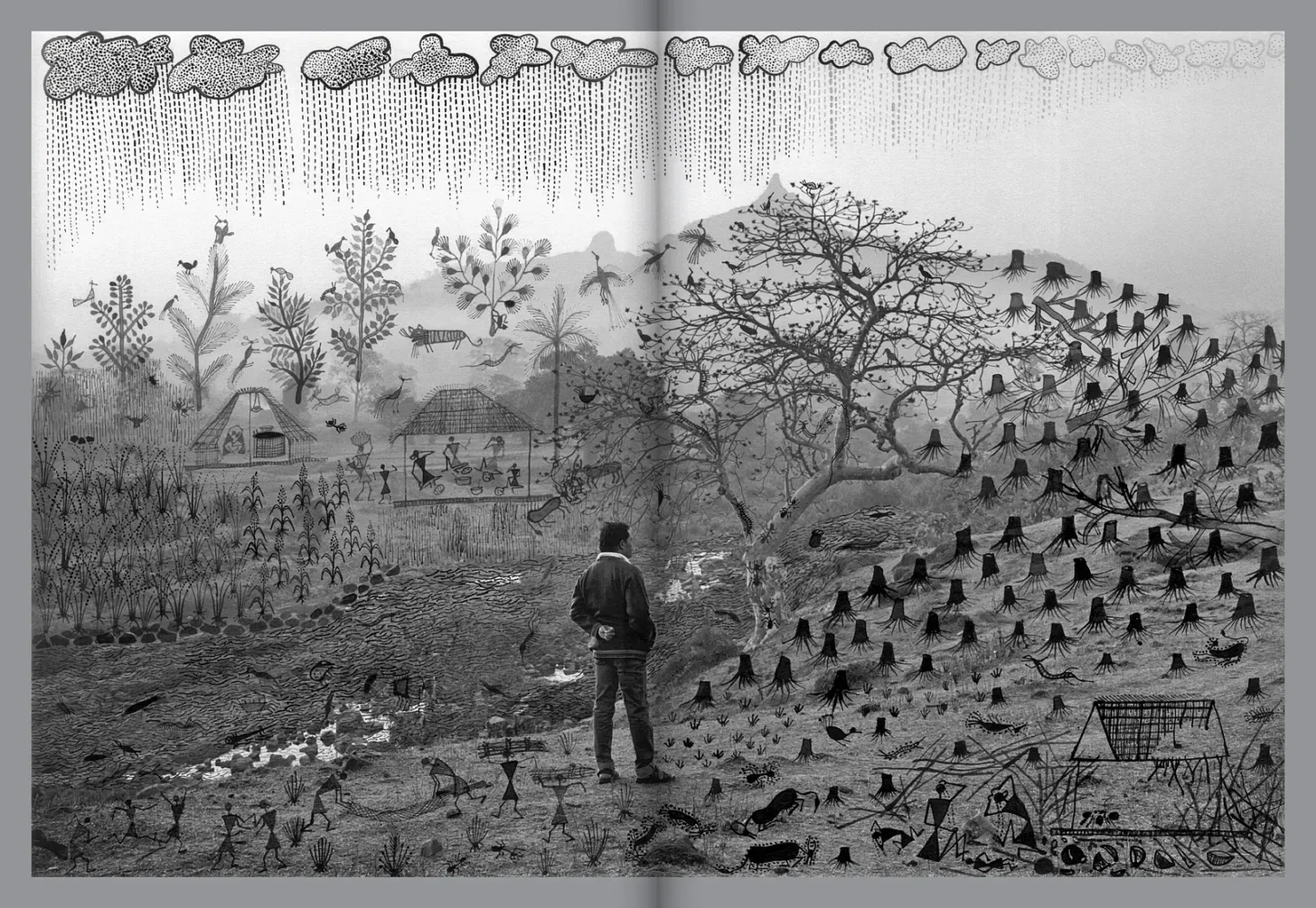
Only a two-hour drive from Mumbai but a world away from the metropolis, Ganjad is a small farming village nestled in the hills of northern Maharashtra’s coastal region.
The population are Warli, an indigenous, or Adivasi, people, who speak an unwritten language and are known for their folk paintings. Traditionally these were painted by women, using a paste made from flour and applied to dung walls inside their homes. Symbolic illustrations in stark white on an ochre background, they would commemorate special occasions such as weddings and harvests.
When I later saw my contact sheets, I realized that so much of the narrative that I had received from Rajesh — the great stories, which had made it come alive for me — was missing. Part of it, I realized, was the limitation — and perhaps, unique presence — of photography, which restricts what is in the image to ‘now’. — Gauri Gill
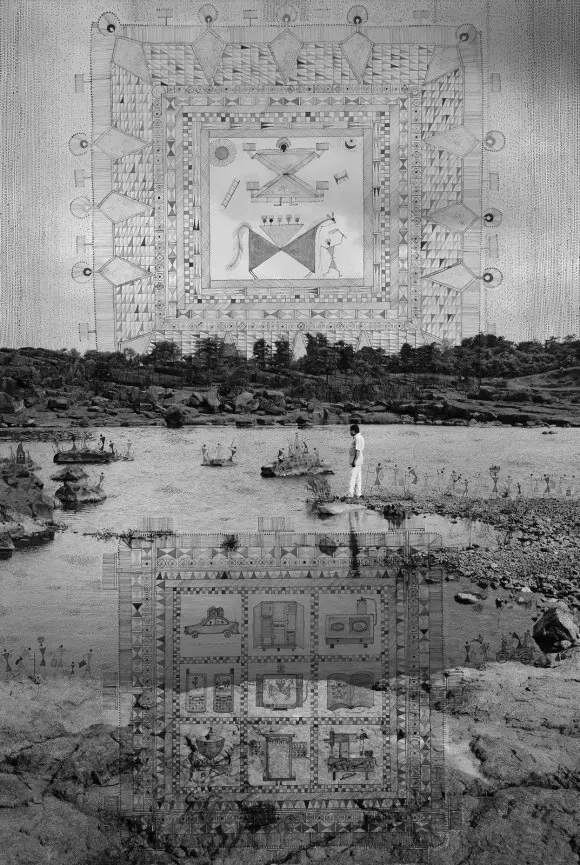
Collaborative, creative, and experimental, Gill and Vangad, in Fields of Sight, provide a new language for art practices that address the politics and aesthetics of environmental destruction.
There is no demarcation between land and sky, all are filled with his stories, nothing is left to profit and production; the only utility possible is that of his stories.
Gill’s photographs become both a setting and a match for Vangad’s intensities.
Refusing to paint over with color the black-and-white photograph, they paint with the same palette but with different intensities, languages, shades, and figures. There are no brilliant colors here. What draws the eye are the somber shades of black and white and the combination (not melding) of divergent styles and languages.
Kuch Hai Features
Wander the region
Profiles and interviews
- Fields of Sight (Georgia Review, Gauri Gill & Rajesh Vangad, Fall/Winter 2018)
- DBPFP 2024: Gauri Gill & Rajesh Vangad (The Photographer's Gallery)
- Another Way of Seeing (Granta, Michael Collins, March 7, 2015)
- Gauri Gill and Rajesh Vangad: Fields of Sight (Trans Asia Photography, Inderpal Grewal, Volume 5, Issue 2, Spring 2015)
- Mr. Rajesh Vangad explains the significance of Varli art and how it portrays Village life (Bhimthadi Jatra, December 31, 2017)
- Fields of Sight (book) (Perimeter Books / Les presses du réel)